
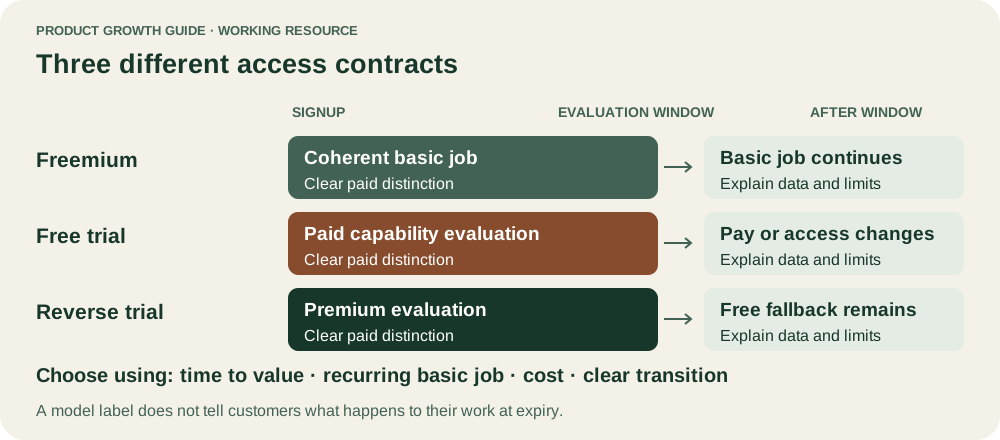
Choose freemium when customers need continuing access to establish value and you can support that access economically. Choose a free trial when customers can evaluate the paid outcome within a realistic time window. Consider a reverse trial when an initial premium experience can help customers understand value and a useful free plan remains after it ends.
None of these models is a substitute for a good product or a clear paid offer. The decision is about what customers need to learn before purchasing, how they learn it, and what happens if they are not ready to pay.
Define the access contract first
Freemium provides an ongoing free version with limits or capabilities that distinguish it from paid plans. A free trial provides temporary access to a defined experience. A reverse trial begins with temporary premium access and then moves nonpaying users to an ongoing free version. Specify whether payment details are required and whether charges begin automatically; those are separate choices.
Wes Bush’s ProductLed chapter on model selection describes multiple free models and argues that their contents should enable customers to experience value. The practical implication is to map the customer’s actual evaluation journey before choosing the label.
Write the contract a customer should understand: what they can do now, for how long, what remains afterward, what costs money, and whether any action creates a charge. A reverse trial is especially confusing if “free forever” and “premium trial ending” appear without explaining the difference.
Find the first meaningful evaluation
List the steps required to experience the paid outcome. A customer may need to connect data, wait for transactions, invite collaborators, secure approval, and complete a recurring workflow. Elapsed time matters as much as interface difficulty.
For an instant image-processing tool, a single successful export may demonstrate the core value. For a forecasting product, one month of actual operating results may be necessary. A short trial can be long enough for the first and structurally inadequate for the second.
Do not use an industry-standard duration as the starting point. Estimate the distribution of time to the meaningful outcome for your eligible segment. Look at people who abandoned as well as those who finished. Among completers, a fast median can hide a large share of customers who needed substantially longer.
Understand the ongoing free job
A sustainable free plan should complete a coherent job. Removing so much capability that customers cannot succeed undermines evaluation. Giving away the entire paid job removes a clear reason to upgrade. The boundary should correspond to a useful difference in need, scope, capacity, or organizational requirements.
For example, an individual may need one personal report while a team needs shared report permissions and scheduled delivery. That is a possible packaging boundary, not evidence that every collaboration product should gate collaboration.
Estimate the cost of supporting free accounts. Include infrastructure, expensive processing, abuse prevention, customer support, and any manual onboarding. A large population of idle accounts may cost little or much depending on the architecture and operating model. Record actual cost drivers instead of assuming that every free user is expensive.
Use the model comparison as a diagnosis
| Decision factor | Freemium may fit | Free trial may fit | Reverse trial may fit |
|---|---|---|---|
| Time needed to establish value | Variable or long | Bounded and realistic | Premium value appears early |
| Useful experience without paying | Clear recurring basic job | Limited need after evaluation | Clear basic job after premium ends |
| Main paid distinction | Scale, team needs, or advanced outcome | Continued access or paid capability | Premium capability experienced during evaluation |
| Free service cost | Can be supported over time | Needs a time or consumption boundary | Basic plan sustainable; premium period bounded |
| Main communication risk | Paid difference remains unclear | Deadline arrives before value | Downgrade is surprising or confusing |
These are editorial decision prompts. They are not a scoring formula or published performance benchmark.
Worked example: a synthetic reporting product
A fictional reporting product helps small operations teams prepare a recurring management report. Initial setup takes two days, but the next report is due every two weeks. A seven-day trial can show setup and sample output without showing the second real reporting cycle.
The team considers three designs. A freemium plan supports one manually generated report and one data connection. A 28-day trial provides team review and automated scheduling. A reverse trial offers those premium features for 28 days, then leaves the manual report available.
The team estimates that the free manual workflow costs $1 per active account per month to serve, while premium scheduling costs $4. These invented estimates exclude acquisition and must be checked against actual usage before a launch decision.
| Design | What customer can evaluate | Main open question |
|---|---|---|
| Freemium | Ongoing manual report | Does automation provide a compelling paid improvement? |
| 28-day trial | Setup plus two reporting cycles | Can customers complete procurement in the same period? |
| Reverse trial | Automation followed by manual fallback | Does the fallback remain understandable and useful? |
The team chooses to test a reverse trial for a narrowly defined self-serve segment. That choice does not mean reverse trials generally win. It reflects a specific combination of early premium evaluation and a sustainable ongoing basic job.
The evaluation should count eligible accounts assigned to each model, successful first and second reports, paid starts at a fixed mature horizon, and service cost. A lower immediate payment percentage could coexist with more retained free accounts and later purchases. A higher immediate percentage could reflect fewer signups or a more aggressive payment requirement.
Measure the whole access journey
Compare models using aligned acquisition populations and observation windows. If one variant requires a card and another does not, the test changes both access and signup friction. You can still test that package, but cannot attribute the result to access duration alone.
Track successful free use, successful premium evaluation, paid conversion, cancellation, and retained paid use. Also record support requests about access changes and charges. Revenue per eligible entrant can be more informative than payment rate among those who survived setup, because model choice may change who starts and completes the journey.
For longer evaluation cycles, separate an early decision from the final outcome. You may be able to rule out a design that causes severe confusion quickly, while needing more time to judge recurring paid value. Define both decisions before launching.
Design the ending as carefully as the beginning
For a trial, warn customers before access changes and explain their options. For a reverse trial, show the future free state early. Indicate what happens to existing data, automation, collaborators, and scheduled work. Customers should be able to understand the consequences without waiting for an interruption.
Consider preserving access to previously created work while restricting new premium actions. That is a product-design option, not a universal entitlement rule. Evaluate it against your promise, service economics, and customer job. A downgrade that unexpectedly blocks important information creates a different problem from a clearly described capacity limit.
Never describe a trial as free if an unavoidable charge or undisclosed automatic transition contradicts that promise. Have the people responsible for product, billing, and customer communication review the same access contract.
Printable access-model worksheet
| Question | Your product’s answer |
|---|---|
| Eligible customer segment | __________ |
| First real outcome and repeat outcome | __________ |
| Required setup, waiting, and approval steps | __________ |
| Time window needed to evaluate value | __________ |
| Coherent ongoing free job | __________ |
| Paid job or capacity difference | __________ |
| Cost of free and premium use | __________ |
| Payment requirement and charging behavior | __________ |
| What changes at expiry or downgrade? | __________ |
| Primary outcome and mature comparison horizon | __________ |
| Retention, confusion, and cost guardrails | __________ |
Further study and limits
For teams deciding what the free experience must accomplish, Wes Bush’s own ProductLed material is a relevant expert resource; the model-selection chapter is the more specific starting point. Its usefulness here is the attention to customer progression and the content of the free offer. That recommendation is for learning, and does not establish a particular result for your business.
A free access experiment can be affected by seasonality, account mix, sales involvement, and pricing changes. Existing customers may react differently from new entrants. Avoid migrating the entire installed base simply because a small new-account test looks promising.
Choose the model that lets the right customer evaluate the right outcome at a supportable cost. Then verify that the promise is clear, the transition is fair, and paid customers continue receiving value after the initial purchase.
Sources
Something we should correct?
Tell the editors ↗