
Choose a pricing metric that customers can understand, estimate, and connect to the value they receive. Check that it can be measured reliably, supports your service economics, and encourages the behavior that makes the product useful. A unit that is easy to count is not automatically a unit customers consider fair.
Start by comparing a few plausible metrics against real customer workflows. Decide the unit before fine-tuning the price. Changing the number cannot repair a fundamental mismatch between what customers pay for and what they are trying to achieve.
Separate metric, price, and packaging
The pricing metric is the unit or basis for charging: seats, transactions, stored records, completed jobs, or another quantity. The price is the amount charged for that unit or package. Packaging determines the capabilities and limits included in an offer. These decisions interact but are not interchangeable.
For example, a plan can include ten seats, advanced permissions, and a fixed monthly fee. Seats are part of the commercial basis; permissions are a packaging distinction. A customer who dislikes paying for infrequent collaborators may object to the metric even when they want the permissions.
Stripe’s usage-based pricing guide describes choosing a value metric that scales with value and is legible to customers. This is a useful starting point. Your evaluation should also examine which behaviors the metric discourages and how confidently a customer can predict a bill.
List the outcomes and the cost drivers
Write the customer outcomes your product supports. Then list the things that create cost for you. They may overlap, but they are not necessarily the same.
An automated document product may create customer value through completed, usable documents while incurring cost through processing attempts, storage, and support. Charging for every failed attempt could cover costs while feeling disconnected from value. Charging only for accepted documents may be understandable but requires a reliable definition of acceptance and protection against misuse.
Keep this tension explicit. A metric needs an economically viable pricing structure, but it should not make customers feel that product failures are their billable responsibility.
Compare candidates on five tests
First, value alignment: does the quantity generally increase as customers receive more useful outcomes? Second, predictability: can customers estimate and monitor it before being charged? Third, incentives: does the metric encourage healthy adoption or create avoidance? Fourth, measurability: can both sides understand and reconcile the count? Fifth, economics: can pricing around the unit cover the cost distribution?
A seat-based model may be predictable for a stable team but discourage inviting infrequent collaborators. A consumption model may fit variable demand but require usage visibility and controls. A flat account price can be simple but poorly aligned with very different customer sizes and service costs.
Stripe’s pay-per-use discussion notes the risks of choosing a metric or curve that discourages behavior or underprices value. The worksheet below turns that concern into an explicit comparison rather than assuming usage-based pricing is always the answer.
Worked example: a synthetic document product
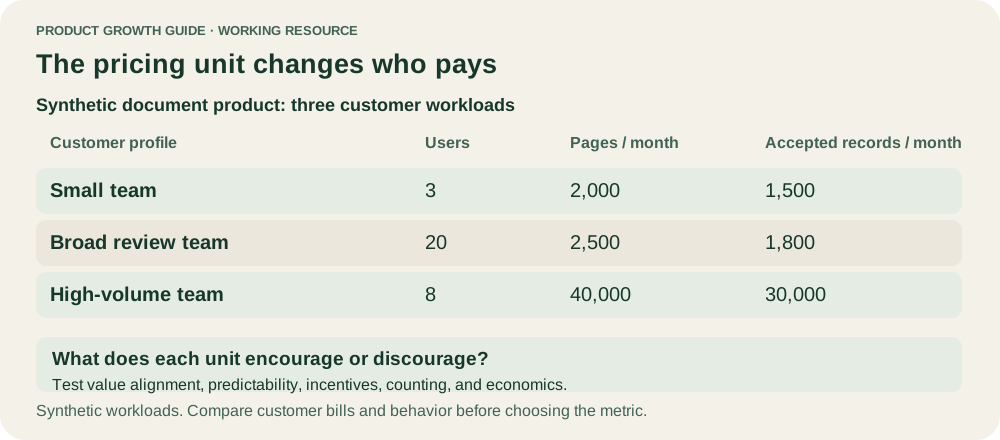
A fictional product converts incoming supplier documents into validated records. Customers care about usable records, reduced manual review, and timely processing. The team compares seats, pages processed, and accepted records. The numbers are invented to show the tradeoff.
| Customer profile | Users | Pages processed monthly | Accepted records monthly |
|---|---|---|---|
| Small coordinator team | 3 | 2,000 | 1,500 |
| Broad review team | 20 | 2,500 | 1,800 |
| High-volume operations team | 8 | 40,000 | 30,000 |
A seat metric charges the broad review team substantially more than the small team despite similar output, and may undercharge the high-volume team relative to service cost. Pages processed track some costs but can vary with document length, duplicates, and failures. Accepted records are closer to the intended output but need a clear definition and handling for later corrections.
The team proposes a base subscription with included accepted records and a transparent additional-record rate. It also records separate internal cost measures for processing attempts and document complexity. This is an illustrative design, not a recommendation that every document product should charge this way.
Before choosing the offer, the team asks customers to calculate their expected bill using their recent workload. If customers cannot do so consistently, the unit or explanation needs work. If they can estimate but feel penalized for valuable collaboration, the metric still has a problem.
Stress-test the incentives
Imagine the customer trying to lower the bill. Would they avoid inviting reviewers, delete useful history, delay a task, split accounts, or refrain from using automation? Some cost-conscious behavior is appropriate. The question is whether the cheapest behavior undermines the product’s useful outcome.
Consider who controls consumption. If a user initiates every billable job, a usage metric may be understandable. If an automated system or external party can create large consumption, the customer needs stronger controls and a clear explanation of responsibility.
A metric based on business results can sound ideal but be hard to attribute. Revenue influenced by a product is not necessarily revenue caused by it. Outcome-based charging needs agreed definitions, measurement, and dispute handling. Do not select it simply because “align with value” sounds compelling.
Build predictable bills into the product
Show current usage, the counting rules, included quantities, and the estimated next bill where appropriate. Explain reset periods and which account members can create consumption. Provide useful notifications and controls before significant unexpected charges.
Design for corrections. If a duplicate event is billed twice, the customer needs a credible reconciliation path. If usage arrives late, define how it affects the current or next period. Reliability of the commercial count is part of the product experience.
For a proposed migration, simulate bills for different existing customer profiles. Identify customers whose payment would rise, fall, or become less predictable. That analysis informs communication and transition design; it does not prove the new price is acceptable.
Printable metric-evaluation worksheet
Use this to compare three serious candidates. Bring examples of actual customer workloads when possible.
| Test | Candidate A | Candidate B | Candidate C |
|---|---|---|---|
| Unit and counting rule | ______ | ______ | ______ |
| Customer outcome represented | ______ | ______ | ______ |
| Can a buyer estimate the bill? | ______ | ______ | ______ |
| Who controls consumption? | ______ | ______ | ______ |
| Useful behavior discouraged | ______ | ______ | ______ |
| Measurement and dispute risks | ______ | ______ | ______ |
| Cost drivers covered or missed | ______ | ______ | ______ |
| Small, typical, and large workload bill | ______ | ______ | ______ |
| Required visibility and controls | ______ | ______ | ______ |
| Next customer or operational test | ______ | ______ | ______ |
Test comprehension before rollout
Present a realistic pricing explanation and ask a buyer to estimate the cost of a recent month. Ask what would make them avoid using the product, who would approve the bill, and what kind of variation their budget can tolerate. Listen for uncertainty, not just stated preference.
Then test the commercial offer with a suitable population and a clear customer promise. Measure paid adoption, realized revenue, service cost, support burden, and continued successful use. Changing the metric and the price together is a package test; avoid attributing the outcome to only one component.
Limits and decision criteria
No metric will align perfectly with value for every customer. Segments may need different packaging, minimums, caps, or contract structures. Avoid adding so many units that the offer becomes impossible to understand.
A pricing metric is ready for broader use when customers can predict it, the counting works reliably, the incentives support useful behavior, and the economics remain viable across plausible workloads. Revenue growth by itself is insufficient if it comes with avoidable confusion or customers restricting the very use that makes the product valuable.
Sources
Something we should correct?
Tell the editors ↗