
Evaluate upgrade prompts by measuring whether eligible customers make an informed paid choice and continue receiving value afterward. Use a stable account-level denominator, a clear observation horizon, and guardrails for task completion, cancellation, support burden, and unwanted interruption. Click-through rate is a diagnostic, not the final decision.
A useful prompt explains a relevant paid benefit at an appropriate moment. It should help a customer decide what to do next while preserving a coherent experience for someone who is not ready to upgrade.
Define the problem the prompt should solve
A prompt may address an unclear plan distinction, an unmet capacity need, an organizational requirement, or a lack of awareness of a useful paid capability. These are different problems. “Conversion is low” does not tell you which message, placement, or offer is appropriate.
Look at what successful free customers try to do next. If they repeatedly need to automate a workflow that the paid plan supports, an automation message may be relevant. If they are struggling to complete the basic free job, an upgrade request may arrive before they can judge the product.
Do not ask a prompt to repair an undesirable paid offer. A clearer message can explain value, but it cannot make a capability necessary or an unclear pricing metric predictable.
Set an eligibility rule before treatment
Define the population that can benefit from the offer. Eligibility might require a relevant task, a supported account type, and the authority to change the subscription. Avoid targeting people simply because a convenient activity metric is high.
For a test, assign eligible accounts consistently and preserve their assignment. In collaborative products, randomizing individual people can expose one account to competing prompts and contaminate the purchase decision. Account-level assignment is often more coherent when payment and plan state belong to the account.
Record eligibility before the prompt changes behavior when possible. If your denominator is “customers who clicked the prompt,” you have already selected on an outcome of the intervention. Comparing upgrade rates within that group can mislead.
Design a truthful choice
Show the paid capability, the relevant plan or price path, and what happens if the customer continues without upgrading. Use language connected to the current job. “Schedule this report automatically on the paid plan” is more specific than a general demand to “unlock your potential.”
Make dismissal or continuation understandable. Avoid repeated interruptions that make the free product harder to use than the promised experience. If a limit is real, explain it before the user invests unnecessary work and provide an appropriate way to preserve or access their existing output.
Check who receives the message. An employee without billing permissions may need a request-to-admin action rather than a checkout link. A buyer needs the commercial details. A technical administrator may need to understand what changes for the account.
Build the measurement bundle
Microsoft Research’s pre-experiment guidance emphasizes a clear hypothesis and a core set of outcome, guardrail, diagnostic, and data-quality metrics. Applied here, that means defining purchase and retained use before optimizing prompt engagement.
| Metric role | Upgrade-prompt measure | Why it matters |
|---|---|---|
| Primary outcome | Retained paid accounts per eligible assigned account | Connects purchase with continued value |
| Early diagnostic | Paid starts, message views, and clicks | Explains the path to the outcome |
| Customer guardrail | Core task completion and abandonment | Detects disruption of useful work |
| Commercial guardrail | Cancellations, refunds, or billing complaints | Detects poorly informed purchases |
| Data quality | Assignment, event coverage, and denominator stability | Checks whether the result is interpretable |
The exact primary outcome depends on your product’s cadence. A monthly workflow needs enough time for another meaningful cycle. State when the initial purchase result is available and when the retention result will mature.
Worked example: a synthetic scheduling prompt
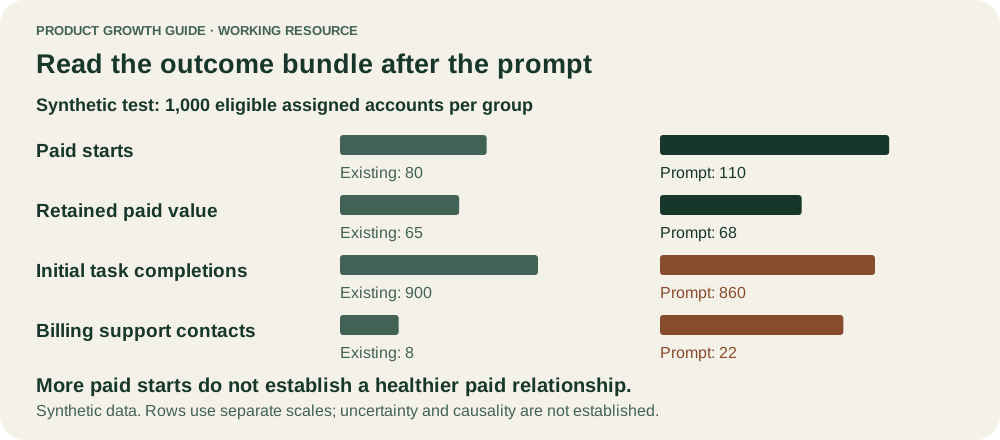
A fictional reporting product offers paid automatic scheduling. It compares the existing experience with a contextual prompt after a customer successfully shares a report. Each group contains 1,000 eligible assigned accounts. The figures below are synthetic and are not claimed as statistically established effects.
| Outcome | Existing experience | Contextual prompt |
|---|---|---|
| Accounts starting a paid plan | 80 | 110 |
| Accounts paid and completing another real report at day 45 | 65 | 68 |
| Eligible accounts completing the initial core task | 900 | 860 |
| Billing-related support contacts | 8 | 22 |
Paid starts rise from 8% to 11%, a three-percentage-point difference. But the retained-success outcome changes from 6.5% to 6.8%, and core-task completion falls while billing contacts rise. Those patterns warrant investigation before a broad rollout. The table alone does not provide uncertainty estimates or establish that the changes are causal.
The prompt may be attracting customers who do not need scheduling, interrupting the sharing flow, or obscuring the billing terms. The team should inspect those mechanisms and preserve the original eligibility population when analyzing results.
A revised test could place the message when a customer explicitly tries to schedule a future report, provide clearer plan terms, and allow an easy manual continuation. That is a new intervention requiring evaluation, not an automatic fix inferred from the first test.
Avoid denominator and timing traps
Report outcomes per eligible assigned account as well as useful diagnostic rates. A prompt can change how many people reach checkout, so checkout conversion alone cannot represent the entire effect. It can also change account activity, making per-session comparisons difficult to interpret.
Microsoft Research’s post-experiment guidance discusses how changes to telemetry and denominators can invalidate metric interpretation. Check whether the prompt changes event collection, account identity, or which observations appear in the metric.
Do not repeatedly inspect a conventional significance test and stop as soon as a favorable result appears. Choose a suitable analysis plan and sample requirement before launch. If you use a sequential method, use the method’s intended decision rules. Early safety monitoring and final efficacy decisions are different activities.
Include delayed consequences
Customers who upgrade in response to urgency may later cancel or complain. Customers who decline a relevant prompt may upgrade after another successful cycle. A short window can favor immediate purchases without showing durable benefit.
Track a mature cohort through the relevant renewal or repeated-use interval. Include service costs and support where those can materially change the economics. Higher recurring revenue is not synonymous with profitability if the new customers need substantially more assistance or processing.
Review exposure frequency. Several individually reasonable messages can become burdensome when combined across the product. Account for other banners, emails, and sales contacts that the same customer receives during the test.
Printable upgrade-prompt test card
| Field | Your plan |
|---|---|
| Customer problem and relevant paid benefit | __________ |
| Eligible account population | __________ |
| Assignment unit and persistent assignment | __________ |
| Trigger, placement, and frequency | __________ |
| Price information and billing permissions | __________ |
| Free continuation or dismissal path | __________ |
| Hypothesis and expected mechanism | __________ |
| Primary retained-value outcome | __________ |
| Early diagnostic metrics | __________ |
| Task, cancellation, and support guardrails | __________ |
| Data-quality and denominator checks | __________ |
| Mature horizon and analysis rule | __________ |
| Ship, revise, or stop decision | __________ |
Limits and a practical ship decision
Low-volume products may not have enough eligible accounts to detect a modest effect quickly. A small qualitative pilot can improve comprehension and catch serious friction, but it cannot establish a reliable conversion lift. State the limit and choose a proportionate rollout rather than manufacturing precision.
A prompt earns broader rollout when customers understand the offer, the relevant purchase outcome improves under a credible analysis, and meaningful guardrails remain acceptable. If the result is uncertain, investigate the mechanism and wait for the horizon needed by the customer job. The objective is an informed paid relationship that lasts, not a momentary spike in upgrade clicks.
Sources
Something we should correct?
Tell the editors ↗