
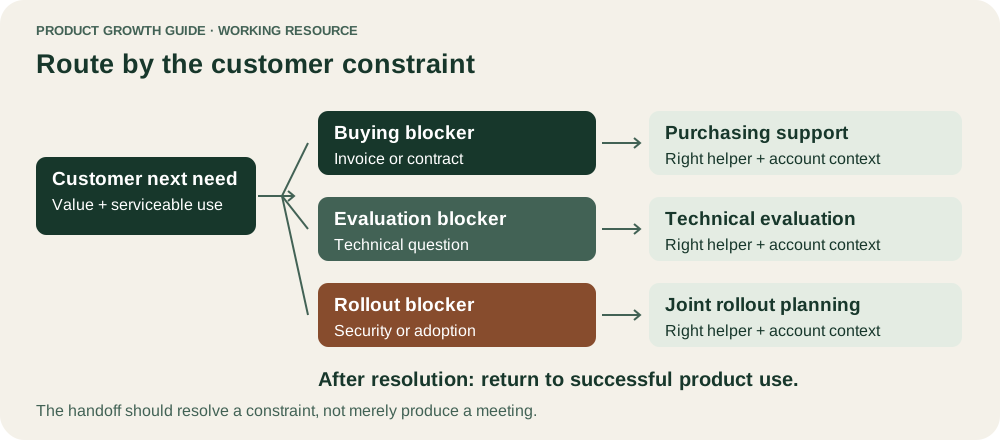
A product-led journey needs sales help when an eligible customer has a problem that product access alone cannot resolve: security review, purchasing approval, organizational rollout, implementation scope, or a negotiated commercial requirement. Route that customer because help can move a real decision forward, not simply because a usage score crossed a threshold.
ProductLed’s discussion of moving from sales-led to product-led growth distinguishes communicating value through people from experiencing it through the product. Keep a self-serve path for customers who can evaluate and buy independently. A handoff should add information and solve a constraint. If it merely interrupts a successful user with an unwanted meeting, it may reduce the value of the product-led motion.
Separate user success from purchase readiness
Someone can use a product successfully without having a budget, buying authority, or organizational need. An administrator can have purchasing authority without being the person who experienced value. The handoff needs to identify both the user journey and the account’s decision process.
Record the customer outcome already achieved, the intended larger use, and the obstacle to that use. “Three active users” describes activity. “Three analysts produced reports, and their manager needs an approved deployment for 40 colleagues” describes a possible commercial opportunity and a reason for assistance.
Reforge’s discussion of product-led sales describes the hybrid relationship between self-serve and top-down growth. That supports treating the two motions as compatible. The routing method below is an editorial framework for deciding where assistance is useful; it is not a benchmark from that source.
Recognize four different kinds of help
First, a customer may need buying help: the right plan, an invoice process, contract terms, or approval documentation. Second, they may need evaluation help: whether the product can perform a specific job reliably. Third, they may need implementation help: data migration, integration, or a deployment plan. Fourth, they may need organizational help: persuading stakeholders or coordinating a broader rollout.
These needs should not all become the same sales call. A simple billing question might be answered asynchronously. A technical question may need an engineer. A broad deployment may require a joint plan involving sales and customer success.
| Customer constraint | Appropriate next response | Information needed |
|---|---|---|
| Needs a purchasing invoice | Clear purchasing support | Account and requested billing method |
| Needs security approval | Security review path | Requirements and responsible reviewer |
| Cannot evaluate an integration | Technical evaluation | System, use case, and observed blocker |
| Wants a broader rollout | Adoption and commercial planning | Current value, target population, owner |
| Wants standard plan upgrade | Self-serve purchase path | Transparent plan and price information |
Routing by constraint reduces the chance of assigning a commercial meeting to a problem that needs straightforward support.
Combine evidence of value with evidence of fit
Use account-level signals where the purchase belongs to an account. A burst of events from one enthusiastic user may say little about the organization’s needs. Multiple people receiving recurring value is more informative, but still does not establish purchase intent.
Fit should reflect actual serviceability. Can the product support the account’s deployment, required geography, technical environment, and buying terms? Intent should reflect a genuine request or behavior plausibly connected to expansion. Keep “unknown” as an available state rather than inferring authority from a job title or readiness from pageviews alone.
A lightweight routing rule can require three things: demonstrated value, a plausible serviceable account need, and an identified obstacle or invitation to help. For explicit inbound requests, do not force the customer to generate usage first. Someone responsible for security may need answers before any rollout can begin.
Worked example: a synthetic analytics account
A fictional analytics product has one workspace with six active analysts. They produce weekly reports, and an administrator requests single sign-on for a planned 50-person rollout. These are invented details for illustration.
The product could send a generic “book a demo” message. A more useful handoff states what happened, what the customer wants next, and what remains unresolved:
Current use: six analysts publish weekly reports. Requested next step: expand to 50 colleagues with single sign-on. Obstacle: security approval and plan requirements. Customer contact: the administrator who requested assistance. Next action: provide the relevant security materials and discuss the rollout requirements.
The commercial team does not need to ask the customer to explain the basic use again. It does need to verify authority, budget, requirements, and whether the requested deployment is serviceable. Product behavior supplies context, not a completed qualification interview.
Now consider another workspace with 20 signups but no completed report. Routing it as a high-value account solely because of seat count risks misdiagnosis. The next useful action may be setup support, research into why people joined, or no intervention at all. A large dormant population is not equivalent to a purchase-ready team.
Define a handoff contract
The receiving team needs enough context to act and a clear responsibility for doing so. Specify the reason for routing, customer-requested channel, responsible person, expected response window, and what happens if the customer declines.
A response window should be an internal operational commitment based on your staffing and customer promise. Do not invent an industry standard. Urgent evaluation blockers and ordinary upgrade questions may need different handling.
Store the customer-facing context in an appropriate account record. Keep access limited to the people who need it. Product analytics should not become an excuse to expose detailed individual activity unrelated to the buying decision. Use the minimum useful summary of outcomes and requests.
Measure whether assistance helps
Count eligible accounts and assigned routing outcomes, not just completed meetings. Meeting volume rewards contact even when the contact is unnecessary. A better evaluation combines constraint resolution, time to decision, successful paid adoption, and retention after adoption.
Also track whether assisted accounts abandon self-serve checkout, wait longer, or submit more support requests. An intervention that raises contract value by forcing a difficult buying process may hurt the overall motion.
For a suitable population, compare an assistance offer with the existing journey using account-level randomization. Give customers the choice to accept help. Analyze all assigned eligible accounts so that highly motivated customers who accept meetings do not become the entire treatment denominator.
When randomization is impractical, use a documented rollout and compare similar account types while stating the limitations. Assisted accounts often differ from unassisted accounts in need, size, and motivation. A higher purchase rate in the assisted group alone does not prove assistance caused it.
Printable handoff worksheet
| Field | Complete before routing |
|---|---|
| Account unit and serviceability | __________ |
| Demonstrated customer outcome | __________ |
| Intended next outcome or rollout | __________ |
| Buying, evaluation, implementation, or organizational blocker | __________ |
| Evidence of request or willingness to engage | __________ |
| Person who can resolve the blocker | __________ |
| Minimum useful context to share | __________ |
| Owner, channel, and response commitment | __________ |
| Self-serve option and decline path | __________ |
| Resolution measure and review horizon | __________ |
| Retention and friction guardrails | __________ |
Plan the return to product use
A handoff should have an ending. Once security questions are answered or terms agreed, tell the customer how to continue. Preserve the useful product context and identify who supports the next adoption milestone.
If the customer is not ready to buy, return them to an appropriate product experience rather than treating the account as lost forever. Record the unresolved constraint so that future assistance begins with useful context. Avoid repeatedly contacting someone who has declined help unless they request a new conversation or your communication agreement permits it.
Where routing rules fall short
Large organizations can contain several buying groups, so one domain may not equal one opportunity. Smaller accounts can have complex needs. Usage can be generated by evaluation teams, consultants, or automated processes. These cases make a universal usage threshold unreliable.
Review incorrectly routed and missed accounts alongside successful handoffs. The objective is a journey where customers can progress independently when that works and receive relevant human help when it changes the outcome. That is a more durable design target than maximizing the number of accounts transferred to sales.
Sources
Something we should correct?
Tell the editors ↗