
Prioritize growth work by identifying the constraint on your current business outcome, comparing plausible interventions in the same unit and time horizon, and accounting for evidence, cost, and risk. Acquisition, retention, and monetization are connected parts of a system. None deserves permanent priority simply because it is your team’s specialty.
Choose a small portfolio with a clear main bet, essential maintenance, and enough learning to address the largest uncertainty. A ranked spreadsheet helps a discussion, but the decision still requires judgment about dependencies and what the business can afford to wait for.
Start with the decision, not the backlog
Write the outcome and horizon first. “Increase retained paid accounts over the next quarter” is different from “generate cash this month” or “learn whether a new segment receives recurring value.” Each goal changes how you compare projects.
Identify constraints using an explicit model. A product that attracts qualified customers but fails to help them complete setup may benefit from activation work. A product with strong recurring value and little qualified demand may have an acquisition constraint. A product with valuable use but an unclear paid offer may need packaging work.
These are hypotheses, not categorical rules. Check the size of the affected population and whether the team can actually influence the suspected constraint. A very weak conversion rate may be a segment-fit problem rather than an interface problem.
Put opportunities in a common outcome unit
If acquisition is measured in visits, retention in return percentage, and monetization in trial upgrades, the opportunities are not yet comparable. Translate their plausible effects into a shared business outcome, while preserving the intermediate metric that the intervention directly targets.
For example, estimate retained paid accounts at a fixed horizon. Keep the ranges broad enough to reflect uncertainty. Do not pretend that an unsupported uplift is a measured forecast. A model should make the assumption visible: “If this change increases eligible activation by five percentage points, and downstream behavior remains similar, this many additional accounts might remain paid.”
A cash-constrained team may also need a cash timing view. A project with a large long-run benefit can be a poor immediate choice if it requires months of investment the company cannot support. That is a constraint worth naming, not hiding inside a low confidence score.
Use scoring to expose assumptions
Intercom’s original RICE framework combines reach, impact, confidence, and effort. It also recognizes that dependencies and other considerations can justify doing work outside score order. Use a score to compare assumptions consistently, not as permission to avoid discussing them.
Keep reach tied to a real population and period. Keep impact tied to the chosen outcome. Confidence should reflect the evidence for the mechanism and the size of effect, rather than the seniority of the person proposing it. Effort should include design, engineering, analysis, coordination, and operational work.
You can use a simpler decision table when numerical estimates would create false precision. Separating a known customer problem from an unknown intervention effect is often more useful than assigning both a single “80% confidence” label.
Worked example: a synthetic subscription product
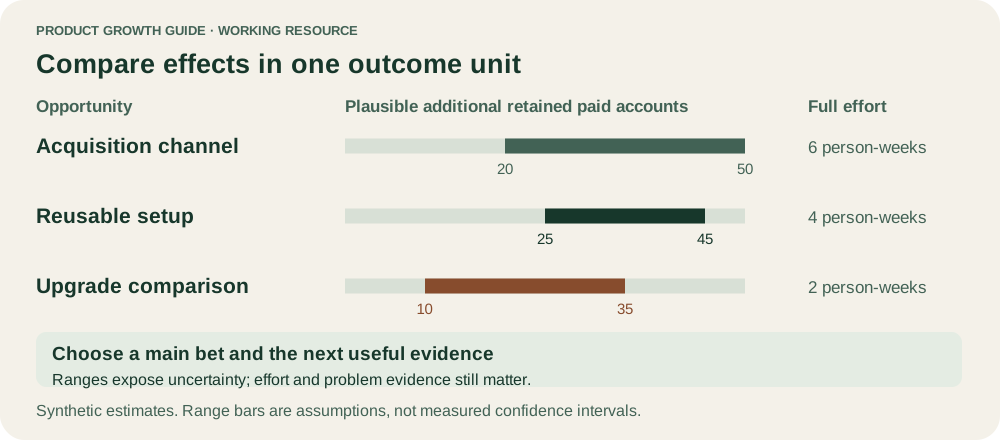
A fictional subscription tool wants more retained paid accounts at the end of a quarter. It currently has 1,000 paying accounts. The team considers a new acquisition channel, a reusable setup configuration, and a clearer upgrade comparison. All estimates below are invented for teaching.
| Opportunity | Assumed mechanism | Plausible additional retained paid accounts | Full effort | Main uncertainty |
|---|---|---|---|---|
| New acquisition channel | More qualified entrants | 20–50 | 6 person-weeks plus spend | New channel intent and cost |
| Reusable setup | More accounts finish repeat workflow | 25–45 | 4 person-weeks | Setup is the true obstacle |
| Upgrade comparison | More successful free accounts select a paid plan | 10–35 | 2 person-weeks | Paid offer is desirable |
The upgrade comparison appears cheap, but cheap does not automatically mean best. If users cannot repeat the core job, a purchase lift may be short-lived. The setup improvement appears promising, but interviews alone cannot establish its effect size.
Suppose support records and direct observation show that users repeatedly re-enter the same configuration, while the acquisition channel is entirely untested. The team selects reusable setup as its main intervention, performs a small demand test for the new channel, and reserves the upgrade comparison until the paid distinction is better understood.
This portfolio addresses the most plausible current constraint while buying information about the next one. It does not allocate a fixed percentage to acquisition, retention, and monetization. Fixed percentages would ignore the specific evidence in front of the team.
Distinguish a delivery bet from a learning bet
A delivery bet changes the customer experience with enough evidence to justify implementation. A learning bet reduces uncertainty so the team can choose a better intervention. Both can be valuable, but their success criteria differ.
For the acquisition example, a learning bet may test whether the intended segment responds to a narrowly targeted offer. Its output is evidence about demand and acquisition economics. It should not be declared a growth success merely because a landing page went live.
For reusable setup, the delivery bet should have an explicit behavioral outcome: more eligible accounts complete the next real workflow. A feature launch and adoption percentage are useful diagnostics, but not the entire result.
Intercom’s problem-definition principle emphasizes understanding and refining the problem before committing to solutions. Apply that by recording what evidence shows the constraint and which assumptions remain about the intervention.
Include risks that a score can conceal
Consider whether an opportunity changes the customer promise, creates billing complexity, depends on unreliable data, or introduces ongoing manual work. Include operational cost after launch, not just implementation time. A small interface change can create a large customer-support burden if it exposes unclear packaging.
Some work is mandatory because the product must function reliably. A broken payment flow or data-loss issue should not compete against speculative growth ideas as if it were optional. State the obligation, schedule it, and compare the remaining discretionary work separately.
Watch for interactions. More acquisition can increase support load and worsen activation. More aggressive monetization can reduce referrals or paid retention. A project that improves one metric may weaken the shared outcome unless these effects are measured.
Printable prioritization worksheet
Use one row per opportunity. Keep the worksheet to the few candidates actually competing for capacity.
| Field | Opportunity A | Opportunity B | Opportunity C |
|---|---|---|---|
| Shared outcome and horizon | ______ | ______ | ______ |
| Customer problem and segment | ______ | ______ | ______ |
| Affected eligible population | ______ | ______ | ______ |
| Proposed mechanism | ______ | ______ | ______ |
| Evidence for problem | ______ | ______ | ______ |
| Evidence for intervention | ______ | ______ | ______ |
| Plausible outcome range | ______ | ______ | ______ |
| Full effort and ongoing cost | ______ | ______ | ______ |
| Dependencies and guardrails | ______ | ______ | ______ |
| Cheapest useful next evidence | ______ | ______ | ______ |
| Decision and review date | ______ | ______ | ______ |
Make the decision revisable
Assign an owner and a review date to each selected bet. Define what would trigger stopping, expanding, or changing it. A review should compare new evidence with the original assumptions, not simply ask whether the team shipped on schedule.
If the main bet fails, identify which assumption failed. Perhaps the problem was real but the intervention did not help. Perhaps the population was too small. Perhaps the metric was unreliable. These lead to different next decisions.
Avoid constantly reopening priorities when no new evidence has arrived. Stable focus helps a team complete meaningful work. Equally, do not preserve the plan when a key assumption has become false simply because a high score once supported it.
Limits of prioritization frameworks
Estimated impact is rarely equally reliable across categories. Acquisition spend can sometimes be measured quickly, while retention requires mature cohorts and monetization needs enough billing cycles. A short evaluation horizon will systematically favor quick visible effects.
Use explicit timing and evidence requirements to counter that bias. The best prioritized plan is the one your team can explain in terms of customer value, business constraints, and uncertainty. It should make clear what you are doing now, what you are learning next, and why the decision would change.
Sources
Something we should correct?
Tell the editors ↗