
Turn discovery into a growth opportunity by connecting an observed customer problem to a specific stage of the journey, defining who experiences it, and stating how resolving it might improve a measurable outcome. Then identify the riskiest assumption and choose the smallest ethical test that can produce useful evidence about it.
An interview quote is a clue, not a complete opportunity. A useful opportunity explains the situation, the consequence, the current workaround, and the behavior you expect to change. It remains open to several solutions until you have evidence for a particular intervention.
Capture a recent situation rather than a general preference
Ask about an actual recent attempt to complete the job. What triggered the attempt? What did the person do first? Where did they get stuck? What happened afterward? What alternatives did they try? These details help distinguish a recurring obstacle from an abstract wish.
If someone says they want a dashboard, ask what decision they were trying to make and how they made it last time. The dashboard may be one solution, but the underlying need could be finding an exception, preparing a report, or obtaining approval.
Separate what you observed from what you inferred. “The participant re-entered the same filter settings three times” is an observation. “A saved view would increase retention” is a hypothesis. Keeping those separate prevents an attractive solution from becoming an invented finding.
Describe the opportunity in customer language
Use a sentence with four parts: segment, situation, obstacle, and consequence. For example: “Operations coordinators preparing a weekly staffing report cannot reuse the correct source settings, so they spend time rebuilding the report and sometimes stop before sharing it.”
That sentence identifies a possible activation or repeat-value problem. It does not yet prescribe saved settings, a template, automated import, or support. Those are competing interventions.
Strategyzer’s roadmap for testing a value proposition separates testing customer jobs and problems, testing a proposed offer, and testing willingness to pay. That sequence helps avoid jumping from “people described a problem” to “they will buy our chosen solution.”
Connect the opportunity to a measurable journey
Identify the stage where the problem matters. Does it prevent a first real outcome, reduce recurring success, block a purchase, or impede broader adoption? Then choose a metric that reflects that consequence.
For the reporting example, the direct outcome could be completing and sharing the next real report within the customer’s reporting cycle. The business outcome could be retained paid accounts at a later horizon. The second is important, but the first is closer to the proposed mechanism.
Do not assign every discovery finding to growth. Some findings identify accessibility barriers, reliability problems, or obligations to existing customers. Those may require action independent of their estimated commercial effect.
Keep an evidence ladder
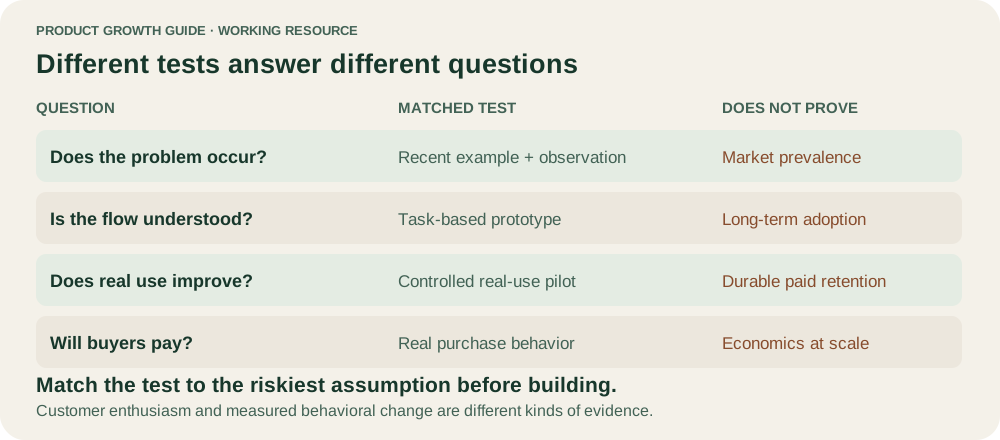
Use different evidence for different questions. Interviews can reveal circumstances and language. Observation can reveal workflow obstacles. A prototype can reveal usability and understanding. A real-use test can reveal whether people complete the job. A paid purchase provides a different kind of evidence about willingness to pay.
Strategyzer’s discussion of customer experiments cautions that experimental approaches vary in reliability, cost, and the influence of the researcher’s presence. The lesson for a growth team is to match the test to the assumption rather than treating every positive response as equally strong.
| Assumption | Useful evidence | What the evidence cannot establish alone |
|---|---|---|
| Problem occurs in real work | Recent examples and observation | How many customers have it |
| Proposed flow is understandable | Task-based prototype session | Long-term adoption |
| Flow improves real completion | Controlled or documented real-use pilot | Durable paid retention |
| Paid offer is desirable | Real purchasing behavior | Economics at larger scale |
Worked example: a synthetic discovery-to-test chain
A fictional team interviews eight coordinators who recently prepared an operating report. Five describe rebuilding the same settings, and three show a recent report they abandoned. These invented counts are a teaching example, not a representative study.
The team records the opportunity as recurring setup friction before report sharing. It considers saved settings, a guided checklist, and a concierge configuration service. Before building a broad automation system, it tests whether reusable settings solve the immediate obstacle.
The hypothesis reads:
For eligible coordinators who have completed one real report, making their previous source settings reusable will increase completion of the next real report within 14 days because it removes repeated setup work.
The statement includes a segment, intervention, behavior, interval, and mechanism. It can be wrong. Coordinators may still fail because the source data is incomplete, or the report may not be needed again within 14 days.
The team first conducts a task-based prototype session to check whether participants can find and correctly apply saved settings. That test addresses understanding. It then plans an account-level experiment among eligible users to address recurring completion. It avoids claiming that prototype enthusiasm proves a retention effect.
| Decision element | Synthetic plan |
|---|---|
| Eligibility | Accounts with one real report and a recurring reporting need |
| Intervention | Reuse prior source settings with explicit review |
| Primary outcome | Next real report shared within 14 days |
| Diagnostic | Setup completion and configuration corrections |
| Guardrail | Incorrect data, support burden, and abandoned reports |
| Stop condition | Material increase in reports with incorrect sources |
| Later review | Paid retention after enough recurring cycles |
Choose a proportionate first test
Test the uncertainty that could change the decision. If you do not know whether the problem exists often enough, instrument the workflow or review a suitable sample before engineering a large solution. If the problem is common but the flow is unclear, a prototype may be appropriate. If the flow is understood but the effect is unknown, real-use comparison is more informative.
A concierge test can reveal whether a result is valuable, but include the manual work in your interpretation. A customer receiving careful human help is experiencing more than software. Document what the person did and which parts would need to be automated or supported at scale.
A fake-door test can reveal interest in an offer, but it should not imply that a capability exists when it does not. Explain availability promptly and avoid blocking an essential customer task merely to collect a click.
Printable opportunity brief
Print this before selecting a solution. Keep the observation and hypothesis columns separate.
| Field | Your brief |
|---|---|
| Customer segment and recent situation | __________ |
| Observed obstacle and evidence | __________ |
| Consequence for the customer | __________ |
| Existing workaround or alternative | __________ |
| Stage of product journey | __________ |
| Outcome event and expected cadence | __________ |
| Competing solutions | __________ |
| Riskiest assumption | __________ |
| Test, eligibility, and comparison | __________ |
| Success criterion and guardrails | __________ |
| Evidence that would change the decision | __________ |
| Owner and review date | __________ |
Decide what the result means
Before running the test, write the possible decisions. A positive usability result may justify real-use testing. A real-use improvement may justify a limited rollout and a longer retention review. A neutral result may mean the intervention did not remove the obstacle, not that the customer problem was imaginary.
Preserve negative evidence. If several participants complete the workflow easily while others fail, examine the circumstances that differ. A narrow segment may have a strong opportunity that a broad average conceals. Conversely, one vivid story may have little reach.
For further study on selecting experiments, David J. Bland’s coauthored Testing Business Ideas is a relevant expert resource. The publisher describes a library of experiment types organized around cost, time, and evidence. That makes it useful when your immediate task is choosing how to test an assumption, rather than selecting a feature to build.
Limits of discovery-led growth decisions
Participants may be unusually engaged, articulate, or available. Accounts that already churned can be harder to recruit. Observed behavior may change when a researcher is present. Report these constraints and avoid converting a small qualitative sample into a market prevalence statistic.
Discovery improves the quality of the question. It does not remove the need to test the proposed mechanism. A strong opportunity brief preserves the customer’s real problem while making the team’s explanation and solution open to challenge.
Sources
Something we should correct?
Tell the editors ↗